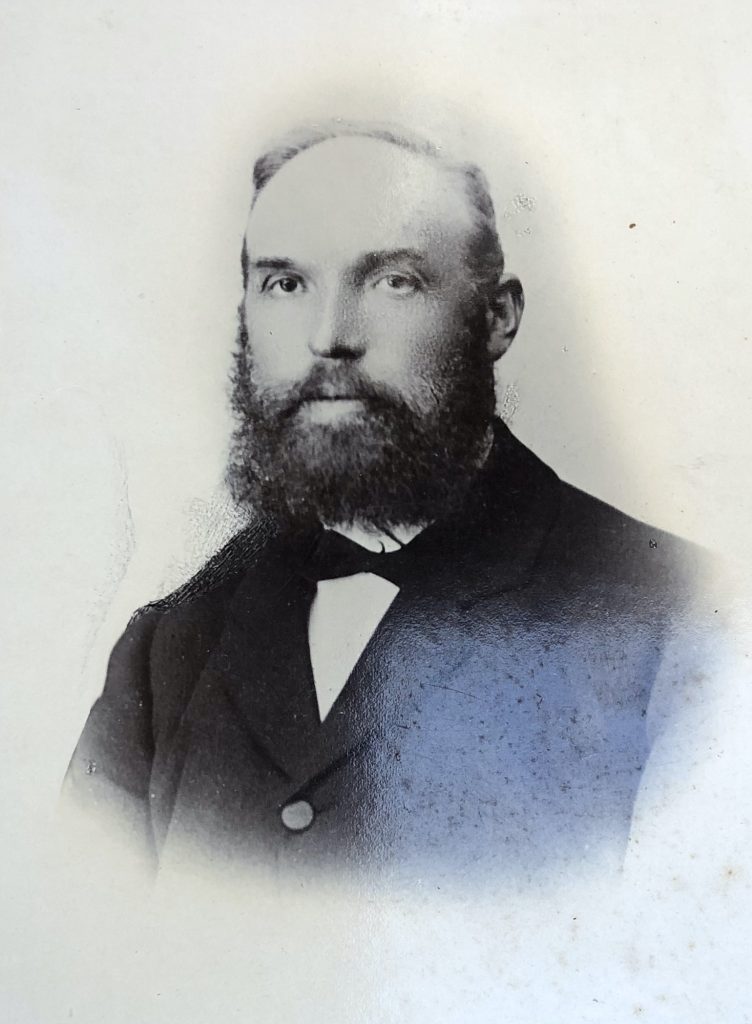
Please accept my heartfelt gratitude for your kind address and valuable present. I feel I am quite unworthy of either. I feel you have greatly overestimated the value of the service of which I was insufficiently able to render.
You make reference to myself personally and [my] christian character — in this I feel I have come very far short.
Since my connection with the church of my youth, it always gave me the greatest pleasure if in any way I could have done anything for the glory of God, or the good of others.
Time after time we have felt our own insufficiency in leading the music of the congregation and to the young ladies we are very grateful who kindly gave us their help. My esteemed friend, Mr David Longwell, gave all the assistance in his power and to him I owe my long continuance.
And now dear friends I kindly thank you for your kind address and valuable gift and my prayer is, may that unanimity and brotherly feeling that has characterised us in times past be ours in future. May we be long spared together and be blessed under the ministrations of our worthy and much esteemed pastor
Yours sincerely
Hugh Steele
Notes: – Spelling corrected in a couple of places and some punctuation added. – David Longwell is listed in Planted by a River, p. 140 as precentor from ‘? – c. 1912’. William John Mooney took over as precentor in 1912. – The pastor referred to would have been Samuel Ferguson, who was the Faughan minister from 1881-1928.
The Reformed Pastor Richard Baxter (updated and abridged by Tim Cooper) Crossway, 2021
The Reformed Pastor is a more controversial book than some of us may have realised. Carl Trueman has apparently called it ‘one of the most depressing, almost psychopathic books on pastoral ministry’. Many of the book’s critics trace its problems to the fact that in the words of R. Scott Clark, Baxter ‘denied the Protestant doctrine of Justification’.
Clark says that Baxter’s works are ‘sprinkled with arsenic’ and should come with the warning: ‘the contents of this volume may be both spiritually useful and harmful. Use only under the supervision of your minister’. Some of the concerns with The Reformed Pastor are highlighted in an article by James Renihan entitled ‘Reforming the Reformed Pastor’.
That being said, The Reformed Pastor has never been lacking in commendations, whether from Spurgeon in his day or Mark Jones in ours (‘I need to read and reread this classic’ he says in his endorsement). Joel Beeke describes it as ‘the type of book you want to read once a year’.
If it is a book to be read regularly, the 600 pages that the book takes up in Baxter’s collected works is a bit of a stumbling block. The Banner of Truth ‘Puritan Paperback’ version is itself an abridgement of around 250 pages. This edition by Cooper is 150, whittling down Baxter’s 160,000 words to 30,000.
Out of all the contenders to do the abridgement, Cooper may well be the most qualified to do it, having been one of the co-editors of Baxter’s mammoth autobiography (5 volumes, only £472.50 from OUP). As Van Dixhoorn says in the foreward: ‘He has so engaged the pastor of Kidderminster’s theological and practical writings that he is able, if I may use the phrase, to think his thoughts after him’.
Baxter’s most famous work will remain controversial – but it’s now a lot more accessible.
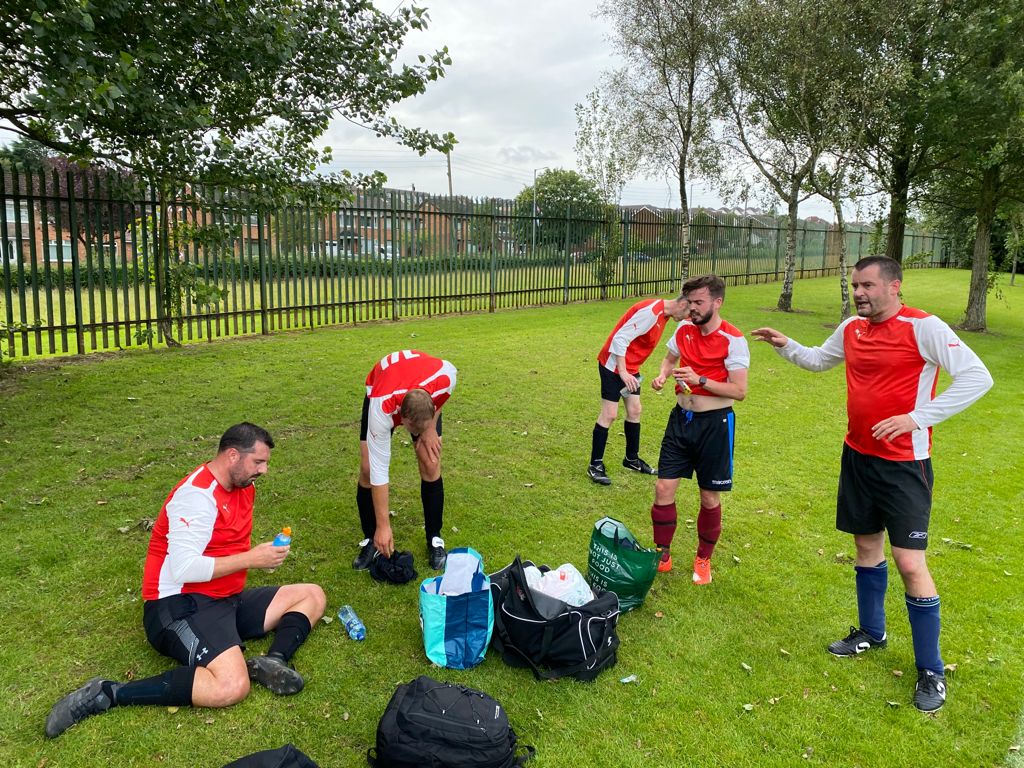
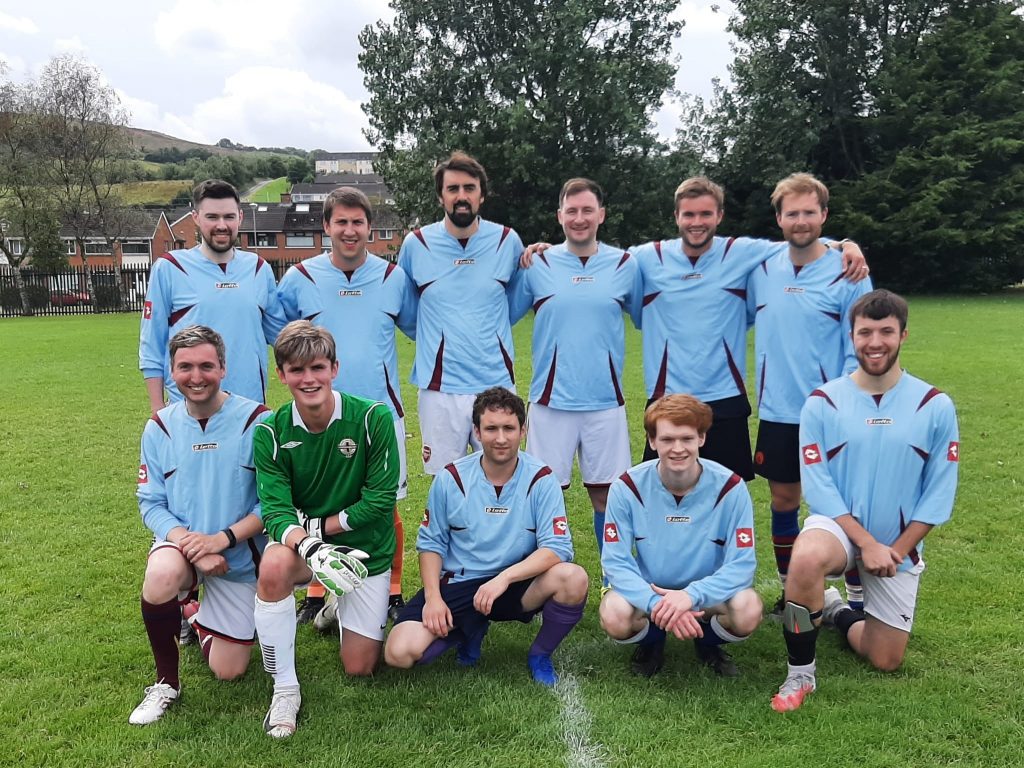
Today saw a highly anticipated reunion match between the original Renwick football team and the generation that followed. Much of the preceding week was spent with Legends searching for their boots and discussing the match on a medium that hadn’t been invented when Renwick took the field for the first time – What’s App. Group members exchanged a record number of messages the day before the match, with goalkeeper Cream Bun pulling out after being ‘pinged’, presumably by his microwave, in the worst excuse for missing a match since Strob dodged one in order to attend a careers fair (some good that did him). After a morning of unsolicited and unqualified medical advice, the resident doctor weighed in, Bun’s absence was confirmed, and attention turned to his replacement. With time ticking down, PMo agreed personal terms and was instructed to deal with anything behind the five metre line.
On the day itself, legends answered the call from Cyprus, London and Scotland to join those still in NI. They descended on the 3 mile water pitches, which were secured by Gav in a heroic effort in the face of many closed Covid doors. The Legends were managed by Dunwoody, and the Youngsters by Morrison. Sadly, despite a search of the Renwick roofspace, only half the legendary Outer Fenn kits could be found (unwashed!), so the Legends were grateful to Conor for providing an alternative.
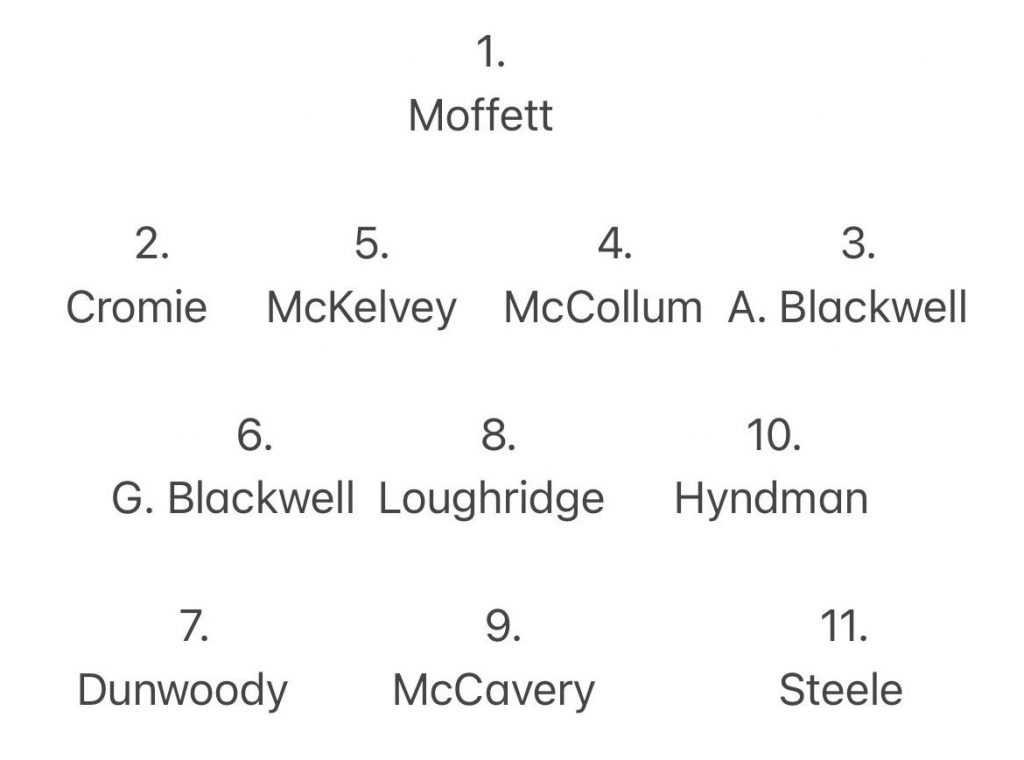
As for the game itself, the Legends took an early lead when a superb ball by McKelvey released McCavery, and the big Cypriot made no mistake to stick the ball in the corner. The Legends were then pegged back when Cromie Joel lobbed PMo. The sides weren’t level for long however – this time it was Steelo’s turn to feed the man from Limassol, who scored his and the Legend’s second. Soon afterwards, the old timers were in dreamland as a ball in from Dunwoody on the right was helped on by Steelo to Loughridge at the back post, and his RPCS colleague made no mistake. For most of the past 16 months, the middle Loughridge brother has been more likely to be classed as high risk due to his advanced age, but he certainly proved high risk in the Youngsters’ box on that occasion.
By this point, the Legends were running like a well-oiled machine, with Stevie a rock at the back, Loughridge and McKelvey bamboozling the youngsters by swapping between centre half and centre midfield, the two Blackwells putting in super shifts in midfield and defence, the oldest Cromie giving an extra option as he surged forward from right back, and PMo sweeping up anything that came near him.
At 3-1, the next goal would obviously be crucial however, and the Youngsters sneaked it just before half time with a low drive by Cromie that sneaked under the keeper at his near post.
After the break, the Legends began to reassert control (despite the arrival of fresh legs for the youngsters in the form of Ben Hannah Captain), but on the 70 minute mark, the ball broke to P Neilly in the box, who scored the equaliser with an unlikely finish.
With the match heading for penalties, disaster then struck at the back to see Cromie Joel pounce to complete his hat-trick. With only six minutes to remedy the situation, the Legends tried to make their superior physical presence count with a number of corners, but saw Loughridge head over twice.
In the last minute of the match, the script seemed to be written as Dunwoody rolled back the years to beat his man down the left wing, before cutting inside and curling in a shot – but Stephen ‘The Cat’ Fallows managed to palm it away at full stretch to break Legend hearts.
It proved to be the last action of the game, but the match has surely whetted appetites for this to become an annual event.
Man of Sorrows, King of Glory: What the humiliation and exaltation of Jesus means for us Jonty Rhodes Crossway, 2021
Man of Sorrows, King of Glory, is about the Lord Jesus Christ in his three offices (prophet, priest and king) and two estates (humiliation and exaltation). It’s theologically on the ball, full of great insights and illustrations, and accessible without being simplistic. The two great pitfalls of popular-level books is that they can mangle theology pretty horribly (Rhodes gives some good examples in his excellent treatment of Christ’s cry of dereliction), or else be above the heads of the average person in the pew. The latter has been my main criticism of Mark Jones’s otherwise excellent books with Crossway. Rhodes however has a real gift for making things simple, and I wouldn’t hesitate to give this book out to anybody. Many of the qualities of Rhodes’ first book (Raiding the Lost Ark, 2013) are on display here – let’s just hope we don’t have to wait another 8 years for his next book!
Oh, and Messiah the Prince gets a footnote – though I would have loved to see Symington quoted on Christ’s Intercession as well!
Men and Women in the Church:A Short, Biblical, Practical Introduction Kevin DeYoung Crossway, 2021
Realising that he didn’t have a short book to hand people on the topic (Recovering Biblical Manhood and Womanhood is 600+ pages), DeYoung wrote this one.
A book like this is certainly needed, and on the whole it does what it says on the tin, but it falls short in a few ways which would make me hesitate to give it out to people.
My main criticism is his willingness to let women lead some elements of public worship. And no matter what you think of that position, the fact that he will let them pray certain kinds of prayers in church but not other kinds of prayers just seems bizarre: “In my tradition, there is usually a long intercessory prayer conducted by one of the pastors. It would not be right in my context to have a woman give this prayer. But I have had women pray in worship services in more specific contexts or in less formal ways”.
His rationale for this stems from his interpretation of the silence of women in 1 Cor 14:34 as only in the context of weighing prophecy. As an attempt to reconcile 1 Corinthians 11 (women can pray and prophesy) and 14 (women must be silent), I don’t think it’s a ridiculous interpretation, but I’m not convinced by it. Not least because it was only first proposed in 1962 and it works best if you understand NT prophecy to be different from OT prophecy (ie you are charismatic). It seems better to understand 1 Corinthians 11 as those like Chrysostom (4th century), Bunyan (17th century) and Warfield (19th century) and others have done throughout church history – taking it as speaking of ecstatic, immediately-inspired prayer and prophecy, which no longer have any equivalent for us now the charismatic gifts have ceased.
Especially since DeYoung is a Presbyterian, he would have been better sticking to the Confessional restriction of vocal leadership in public worship to those ordained or intending the ministry (see WLC 156 & 158-9, Directory for Public Worship and Form of Presbyterial Church-government). The conclusion of Hart & Muether (in With Reverence and Awe), that ‘the key distinction in worship is not gender but ordination’ is much better and more consistent.
There were also some other bits I found unsatisfactory, such as his section on prophetesses. For example Andrew Steinmann’s treatment of the same issue (in passing!) in his commentary on Nehemiah which I read the other week is much stronger. DeYoung argues that ‘women prophetesses carrying out their ministry differently from male prophets’ whereas Steinmann emphasises the times in which they lived, pointing out that ‘Only Huldah was inspired to utter true prophecy, and she lived in the grim final days of Judah, shortly before it fell to Babylon’.
On the whole the book has much to commend it, and seeks to make a positive case for complementarianism, showing how it’s based on nature rather than arbitrary rules. His final two chapters, on ‘Growing up as boys and girls’ and ‘Following Christ as men and women’ are particularly helpful. If I were to preach a series on manhood and womanhood, it’s definitely a book I’d turn to. It’s good on the big picture but just a bit woolly in applying some of the principles to the church – which is a pity for a book entitled ‘Men, Women and the Church’.
His ability to use 1 Corinthians 14:34 ‘As in all the churches of the saints, the women should keep silent in the churches’ to argue that ‘churches that do not allow women to speak in church under any circumstances are contradicting the instructions of Scripture’ is unfortunate and means the book may confuse some people more than help them. For those who are unlikely to be swayed by that exegesis though, there is much here that is helpful.
(Though can someone tell DeYoung/Crossway that ‘helpmate’ isn’t actually a biblical word, but a misunderstanding of the KJV of Genesis 2?)
Surviving Religion 101: Letters to a Christian Student on keeping faith in College Michael Kruger Crossway, 2021
When he went to College, Mike Kruger took an Introduction to NT class taught by a young, bright, engaging scholar who had previously been an evangelical. His name was Bart Ehrman. That experience led Kruger to explore his own faith more deeply, and has now resulted in him writing this series of letters addressed to his daughter who is just about to start the same university. The book covers topics like the preservation of Scripture, canon and contradictions in the Bible – but also more emotive ones such as Hell and homosexuality. There’s actually a fair bit of overlap between this book and Crossway’s excellent 2019 title Confronting Christianity.
Don’t think of it as just a book to hand students going off to university, however. The material would be really useful for preparing a series of apologetic talks, or working into sermons. In fact, Kruger asks in the introduction: ‘Why are our Christian college students not better prepared intellectually? Is it because, perhaps, our churches in general are not intellectually engaged with their faith? And is that due (at least in part) to having ministers who are also not thinking (and teaching) deeply about the Christian faith?’ (He then goes on to ask is that a problem with the seminaries).
All in all, it’s a really helpful book both to hand out to people, but also for ministers to work through and make sure they’re engaging with these questions in their preaching.