Two new books on the Psalms in Worship

Update: Look out for Malcolm Ball’s review of Le Febvre’s book in the January edition of the Covenanter. Malcolm reckons that everyone should get 2 copies (1 to keep and 1 for a friend) and quotes the author’s conclusion which is particularly relevant to us RPs: “Even within a denomination that sings the Psalms exclusively, there is need to relearn what we are doing as we sing these curious specimens of ancient hymnody.”

—

Two new books arguing for a return to using the psalms in worship have just been released – both of which look very promising.

Singing the Songs of Jesus

The first is Singing the Songs of Jesus, written by RPCNA minister (and ex-Airdrie psalm expositor) Michael Le Febvre. The blurb from Christian Focus reads as follows:

The Psalms were composed for singing. In Old and New Testament times, and throughout Church history, congregations sung Psalms. Despite renewed interest in Psalmody, few books explain how the Psalms function as hymns for Christ-centred worship. Singing the Songs of Jesus fills that gap without shying away from difficulties, like the doubts and curses of the Psalms. This study shows why the Psalms are suited for Christian praise and how to use them for powerful and relevant worship.

The book doesn’t argue explicitly for exclusive psalmody (though of course, that’s what he believes), and so will not put non exclusive-psalmists off straight away – but, as the book’s editor told SWS, if you take Le February’s arguments to their logical conclusion, that’s probably where you’ll end up.

Carl Trueman, someone else who prefers filet mignon to mince and onions, has written a short review here, describing it as “Well worth purchasing, reading, and meditating upon”.

sing a new song - beeke selvaggio

The second book is Sing A New Song: Recovering Psalm Singing for the Twenty-First Century. It’s published by Reformation Heritage Books and is edited by Joel Beeke and Anthony Selvaggio – another American RP minister, as well as occasional Messenger contributor. The publishers write:

The book of Psalms occupies a unique place in Scripture, being both the Word from God and words to God from His people. Unfortunately, psalm singing no longer plays an integral part of worship in most evangelical churches. In this book, thirteen well-respected scholars urge the church to rediscover the treasure of the Psalms as they examine the history of psalm singing in the church, present biblical reasons for the liturgical practice, and articulate the practical value it provides us today.

The contents and contributors (not all exclusive psalmist) are as follows:

Foreword: W. Robert Godfrey
Part I: Psalm Singing in History
Chapter 1 Hughes Oliphant Old and Robert Cathcart: “From Cassian to Cranmer: Singing the Psalms from Ancient Times until the Dawning of the Reformation”
Chapter 2 Joel R. Beeke: “Psalm Singing in Calvin and the Puritans”
Chapter 3 Terry Johnson: “The History of Psalm Singing in the Christian Church”
Chapter 4 D. G. Hart: “Psalters, Hymnals, Worship Wars, and American Presbyterian Piety”

Part II: Psalm Singing in Scripture
Chapter 5 Rowland Ward: “Psalm Singing and Scripture”
Chapter 6 Michael LeFebvre: “The Hymns of Christ: The Old Testament Formation of the New Testament Hymnal”
Chapter 7 David P. Murray: “Christian Cursing?”
Chapter 8 Malcolm Watts: “The Case for Psalmody, with Some Reference to The Psalter’s Sufficiency for Christian Worship”

Part III: Psalm Singing and the Twenty-First-Century Church
Chapter 9 Anthony T. Selvaggio: “Psalm Singing and Redemptive-Historical Hermeneutics: Geerhardus Vos’s ‘Eschatology of the Psalter’ Revisited”
Chapter 10 Derek Thomas: “Psalm Singing and Pastoral Theology”
Chapter 11 J. V. Fesko: “Psalmody and Prayer”

I’ll hopefully be getting Le Febvre’s book on Saturday, if you know what I’m saying!

Reformation in Secret Prayer

“I ought not to omit any of the parts of prayer – confession, adoration, thanksgiving, petition, and intercession.
There is a fearful tendency to omit confession, proceeding from low views of God and his law – slight views of my heart and the sins of my past life. This must be resisted. There is a constant tendency to omit adoration, when I forget to whom I am speaking – when I rush heedlessly into the presence of Jehovah, without remembering his awful name and character – when I have little eyesight for his glory, and little admiration of his wonders. ‘Where are the wise?’ I have the native tendency of the heart to omit giving thanks. And yet it is specially commanded, Phil. 4:6. Often when the heart is selfish – dead to the salvation of others – I omit intercession. And yet it especially is the spirit of the Great Advocate, who has the name of Israel always on His heart.
Perhaps every prayer need not have all these; but surely a day should not pass without some space being devoted to each.”

Robert Murray M’Cheyne

Challies forces reprint of ‘The Cross He Bore’!


“Perhaps the best thing Banner have produced in the last 10 years” – Mark Loughridge

Tim Challies, the world’s most famous Christian blogger ®, has exhausted Banner of Truth’s worldwide supply of Professor Leahy’s book The Cross He Bore, after describing it on his website as ‘the best $4.03 you’ll ever spend’. With the US supply exhausted, Banner flew all the copies of it in their Edinburgh warehouse over to America, but they still hadn’t enough to satisfy the 100+ orders Challies had generated.

According to Banner’s North American manager Steve Burlew, “I have been assured that we will reprint it, but that process will take some time. I’ll keep you posted.”

So for those of us who do have access to this now much sought after book, we should probably read it! It is available from the Covenanter Bookshop, and our American friends can still buy it from Crown and Covenant.

You can listen to a number of sermons by Professor Leahy on the RP site.

IN OTHER NEWS…

Sponsor Dean!

dean with bill murray

Dean (pictured left) is doing a trek in the Sahara for Action Cancer in Februrary, and needs to raise at least £2,000 by then. You can sponsor him here.

Sherlock Holmes on suicide

Here are a couple of quotes from Sherlock Holmes that I found interesting, the first shows how attitudes to suicide have changed. In it he is talking to a woman whose face was badly mutilated by a lion who he suspects is thinking about killing herself:

‘Your life is not your own,’ he said. ‘Keep your hands off it.’
‘What use is it to anyone?’
‘How can you tell? The example of patient suffering is in itself the most precious of all lessons to an impatient world’.
The Veiled Lodger

Sherlock Holmes on (vaguely) God:

‘Our highest assurance of the goodness of Providence seems to me to rest in the flowers. All other things, our powers, our desires, our food, are really necessary for our existence in the first instance. But this rose is an extra. Its smell and its colour are an embellishment of life, not a condition of it. It is only goodness which gives extra, and so I say again that we have much to hope from the flowers.’
The Naval Treaty

Are you Jackie Fullerton in disguise?

With Stute TV’s regular correspondent missing on Thursday night I had to interview Stute manager Liam Beckett, in what turned out to be the most scathing interview he’s ever done! As you may notice, a certain other Stute fan tried to put me off by ringing me in the middle of it, but I just managed to stop the phone ringing in time!

Pretty depressing morning

Update: It has emerged that the two regulars missing from the Renwick panel today weren’t there because they were away home to vote. Seriously!

Also, here’s a good quote from the late Rev Prof Adam Loughridge in an old Messenger interview that I would have put in the voting post if I’d seen it yesterday (though of course it could be applied to a lot more things):

A weakness is that there is almost a spirit of apology for our existence. There is not enough positive commitment to the RP position, and the principles of the church.”

Original post:

Image006

The two hundred and six lorried away and our match against BBC called off due to a couple of late Renwick drop-outs.

Yesterday, on the other hand, was pretty good. For one thing, my hard flat out final year under pressure work consisted in reading a pamphlet on “Divine Psalms against Human Paraphrases and Hymns” (1861) by RP Legend Thomas Houston!

Image003

I also was greatly amused to see on a shelf in Union’s 19th Century Pamphlet Collection (yes, beat them in football, mock them, and use their resources) a copy of the book with one of the greatest titles of all time: The Dippers Dipt: A Refutation of the Anabaptists

Image004

thedippersdipt

Intrestin’ facts

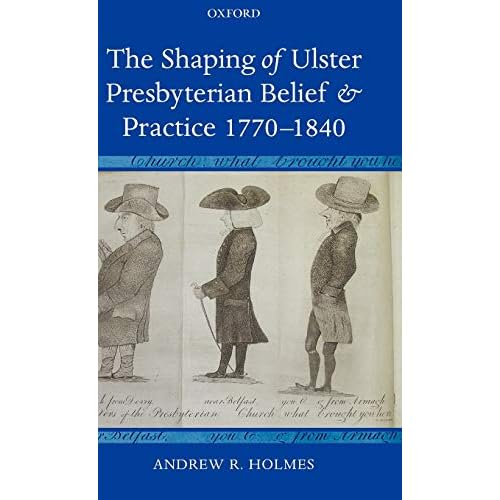
I don’t normally read history books for the craic, but I was persuaded to get Andrew Holmes’ The Shaping of Ulster Presbyterian Belief and Practice, 1770-1840 for Christmas. I found it highly interesting, despite the fact that RPs don’t get much of a mention. Most of it is about the Synod of Ulster (‘the great unwashed’) and the Seceders (RP wannabees) (these 2 groups united in 1840 to form the PCI) and the non-subscribers. Indeed, the worst thing about the book is probably having to read so much of the guff that the dirty non-subscribing / arian / unitarian / bring your dog to church / ‘New Light’ gypsies believed! But I suppose you can’t tell the publishing wing of Oxford University that you’re going to leave out a group just because they happen to be heretics…

So anyway, here’s some things I found particularly interesting (I’m not saying whether I agree or disagree with them, just saying they’re intrestin’):

– During this period no Presbyterians held services on Christmas Day (p 92). Of course, no-one did back in the day, but I assumed most Presbyterians had started it pretty soon after 1690. So it hasn’t been an RP distinctive for as long as I thought!

– Reading sermons was seen as at best patronising, if not a sign of heresy!

– The Marrow controversy (mainly involving the Free Offer of the Gospel) saw the Covenanters & Seceeders pitted against the rest. “Both Seceders and Covenanters freely offered the gospel of Christ to everyone, irrespective of their spiritual attainments. In the late eighteenth century, the Covenanter minister William James charged John Holmes of the Synod of Ulster with doctrinal error in not offering the gospel to sinners but only to those who had prepared themselves for salvation. Opponents argued that the free offer of the gospel repudiated the teaching of the WCF by expounding universal salvation and denying that Christ had died only for the elect.” (p 131)

– In the late 1700s a Seceder minister tried to hold a (open air) communion at Lylehill when “Crowds of dissolute or thoughtless persons came from Belfast” – no change there then!

– Also on the subject of communion: “Following Calvin, conservative Presbyterians held that Christ was spiritually present to those who were of the elect…Reflecting the influence of rationalism, non-subscribers held that the bread and wine were merely symbols or representations of Christ’s body and blood upon which the believer was to meditate.”(p 186)

– The first moves to get rid of communion tokens (predictably) came from non-subscribers, with Henry Montgomery (Henry Cooke’s arch-rival in the Arianism debate) arguing that the ‘only tokens God requires from sinners are penitence, faith and love’. Also “as early as 1826, at least one non-subscribing congregation had ‘laid aside many years ago’ the distribution of tokens.” (p 172)

– RPs disciplined people who voted in elections (yooooo), registered leases (?), served on juries (?), signed parliamentary petitions (?) or took oaths of allegiance. (p 174)

– AH sums up one of the rules of the 1815 Irish edition of the Short directory for religious societies in the Covenanting Church – “There were to be no gender-specific meetings to ensure that men were able to control female fancy and frivolousness.” (p 291)

Covenants:

– “The Seceders in 1744 made the renovation of both Scottish covenants…terms of Christian communion” (p 167)

– “Ulster Presbyterians saw themselves as a separate community and a covenanted people” (p 306) This refers to both Covenant Theology and the Covenants of 1638 and 43. Covenant Theology was big throughout the period. There was more attachment to the Covenants from your average Presbyterian than you might think (I thought they hated them!) but towards the end of the eighteenth century this was dying out:
“A commitment to the perpetual obligations of the religio-political convenants [ha! they can’t even spell Covenant in the PCI!!] of 1638 and 1643, for example, was not universally shared by Presbyterians and, indeed, became less important for conservatives from the 1780s.” (p 307)

However 60 years later when the PCI was formed they were once again slipping back in the direction of being wannabe Covenanters:

“The increasing evangelical character of Presbyterianism led to the union in 1840 of the Synod of Ulster and the Secession synod…The union was interpreted as a product of the ongoing revival of religion since the early 1800s…the list of principles underlying the union reflected a desire to return to the doctrines and practices of seventeenth-century Scottish Presbyterianism…It was agreed that these ‘principles claim the admiration of every lover of the ‘good old way’ which was trodden by the Church of Scotland in her days of Covenanted Reformation.’ ” (p 311)

Of course with the Covenants forming no part of their union despite their objectives being unfulfilled and never having been shown to be unbiblical (and so still binding on the nation), I think the only response to that last quote would be ‘keep telling yourselves that!’.

Some books we sell at the Covenanter Bookshop…

Calvin’s teaching on Jobs

Jobs are sortof important apparently, so if you can’t decide what you want to be when you grow up / leave uni and have failed in your attempts to become a spy, astronaught or professional footballer, why not turn to this book to see what the greatest Reformer of all said on the subject.

Wesley and Men Who Followed Iain H. Murray

Just why exactly do men follow Iain Murray? Is it his great books or his work in founding the Banner of Truth? And what exactly does Wesley have to do with it all?! Find out in this must-read book!

ministeringlikethemasterstuartolyott

Ministering like the Master Stuart Olyott

If you’re going to preach, you’ll want to follow in the footsteps of one of the greatest preachers of our generation, Northern Ireland winger and pastors’ pastor Stuart Olyott. This books will enable you to preach just like the master himself!

We also have a few biographies of John MacArthur, probably the greatest man to ever live. The latest of the authors to try and add to MacArthur’s many biographies include Battle Beginning and The Gospel According to the Apostles.

We also stock the book that tells us the only way to get on in life – if it came from anyone else it would be arrogant, but it’s not anyone else it’s:

Follow Me – John MacArthur

Anyway, back on planet earth, the 2006 Student Book Night will be held on Tuesday (5th December) in Renwick at 7:30pm. There will be at least 20% off all books. All students are welcome (and, in fact, encouraged!) There may be food, Tom is getting back to us on that one.

In other news: Stevie told Jonny who told me that the artist formerly known as Ruth Forgrave will be featuring on Season Ticket this week (Wed – BBC One – 11:10pm) as she got to some final but didn’t / isn’t playing because it’s on a Sunday. Season Ticket are therefore apparently following her around for a Sunday to see what she actually does instead. Should be good, if indeed it’s not just more vicious rumours.

Finally, could I urge the general public to pay attention to the following warning:

Coates and Johnson EP

Finally Finally – I keep forgetting to mention this, just like I kept forgetting to mention the Renwick end-of-season dinner and Peter had to think it up himself! Jonny has come up with the idea of Renwick v. the RP ministers (the college boys can play for them too). Just something else to consider!