The Church is a spiritual society composed of all who are, in Christ Jesus, and is embraced as a perfect whole, in the Eternal Purpose and Covenant of Jehovah. The Church Visible consists of those who profess the true religion, with their children. The word is applied in the New Testament to the κλητόί, the á¼ÎºÎºÎ»Î·ÏƒÎ¯Î±, the called and gathered of any particular place, who avow their faith in Christ and obedience to Him, and who, separating themselves from the world, statedly assemble for His worship and service. It is also applied to the aggregate of such assemblies throughout the country or throughout the world. To enable this Church to secure the ends of her existence, office-bearers exist by direct Divine appointment, to whom a variety of names, indicating diversity of work, is given.
The office of Teaching, being the most important, embraces within itself all the offices. Hence the names Pastor, Bishop, Presbyter, Deacon, are all given to the Teacher. After the Teacher, all the officers given to the Church are officers of administration. The word Pastor designates the officer whose business it is to take care of all the spiritual interests of the flock. The Greek word επισκοπος, “overseer†or “bishop,†represents the same office in its application to different kinds of work, as illustrated by its use in the Roman Empire. The term Ï€ÏεσβÏτεÏος, elder, was the title of an officer which existed from time immemorial in the Jewish Church, subsidiary to the higher functionaries of the Temple and Synagogue, one to whom was committed the administration of ecclesiastical law throughout the community. As effective teaching is due largely to personal and authorative administration, the Teacher must be invested with full power in this department also; and, therefore, he is not only Pastor, Overseer, Presbyter, but by reason of his higher office, he presides in the meetings of the Presbyters, and is called by way of eminence, the Pastor or Bishop of the congregation. But the single Teacher is never the sole ruler in any congregation, and his office of teaching confers upon him no superiority of rank or power in administration, over his fellow elders.
Specially is there needed a class of officers belonging to and mingling with the people, who shall exert, not merely a personal, but an official influence and power, as the appointed administrators of the law of Christ. Now this is just what the constitution has provided, when it requires the existence of a number of Ruling Elders in every congregation (see Rom. xii. 8., 1 Cor. xii. 28., 1 Tim. v. 17.) It is now conceded that the Ï€ÏεσβÏτεÏος and the επισκοπος in the Apostolic Churches were the same, the words being used interchangeably. A number of these were ordained in every church and it was to the whole, in their joint capacity as a Session of Presbyters, that the power of government and the Pastoral oversight of the members were committed. Whether the teaching was stated or occasional, the provision for the exercise of discipline and the administration of affairs was, from the beginning, an integral and abiding part of the local organisation. Teachers at first came from without, as the messengers of the Churches—the ambassadors of Christ. When settled in a particular sphere, they became Pastors as well as Teachers. But even in their absence, the flock was not left without pastoral instruction—elders being selected, because they were “apt to teach,” as well as fit to rule. All rule and administration in the Church involves a measure and kind of instruction, which, while it does not trench in the least upon the work of the official Teacher, is yet of the utmost value in giving character and efficiency to Church power. The late Baron Bunsen observes “The hypothesis of the Presbyterian Divines of the Sixteenth and Seventeenth centuries, that the elders form both an officiating and ruling body is quite correct.” (Hippolytus and His Age, Vol. III. 221.)
The recently discovered ” Teaching of the Apostles,” [a Greek copy of the Didache was found in 1873 and published in 1883, with an English translation following in 1884] shows conclusively, that the organisation and order sanctioned by the Apostles continued to prevail during the first half of the second century. Chapter XV. is as follows:—“Appoint therefore for yourselves bishops and deacons worthy of the Lord, men meek and uncovetous and true and approved, for they too minister to you the ministry of the prophets and teachers. Therefore despise them not, for they are the honoured among you with the prophets and teachers.” That the Elders continued to hold the same place of dignity and power during the later half of the second century and afterwards, despite the gradual encroachments of a clerical episcopacy, is admitted by Mr. Hatch. “It is clear from the exhortation of Polycarp to the presbyters of Philippi, that those presbyters had the supreme oversight of all matters of administration. It was their duty to visit the sick, to provide for the widows and orphans and poor, to turn back those who had gone astray from the error of their ways, to sit in merciful judgment on those who had committed wrong. The building in which they assembled came to be called a Basilica or court-house; the part of it in which they sat a Tribunal or judgment seat; they were chiefly courts of discipline. Nor does it appear that any of these duties ever wholly ceased to be the duties of the presbyterate. The presbyters were, in theory, the Council of the bishop, even after the bishop had asserted a virtual autocracy.” (Bampton Lectures, p. 66. [1880])
Having thus shown the original design of the Eldership and the place assigned to it, it will be the less needful now to enlarge upon its qualifications and duties; still, the following classified statements are submitted :—
1. QUALIFICATIONS.—1. The Personal qualifications of the Ruling Elder must always be placed in the foreground. Whatever may be the rank, the affluence, the ready serviceableness, or complete self-confidence of the man, his personal character must form the ground work of the people’s choice and of his own acceptance of office. The very name by which it has been known from the remotest ages is suggestive, of the ripened gifts and matured wisdom of hoary-headed men. Old age is not in itself a qualification, nor is it necessary that the Elder should be an aged man, for Solomon says, Wisdom is grey hairs. But the fixed principles, the sound judgment, and the developed graces of Christian character which encircle seniority with respect and influence, should in no case be wanting. The Elder must be known to be a man of God, whose life is in unison with the life of Christ, and who is in full sympathy with His people and cause. Standing clearly in advance of the average member of the congregation, he ought to be “an ensample to them that believe, in word, in manner of life, in love, in faith, in purity.” If he is to guide others, the lamp of true religion should burn brightly in his own hand and house. If he would stimulate the languid and strengthen the weak and minister to the spiritually diseased, he must sparkle with electric healing virtue. If he would comfort the sorrowful, his own consolations in Christ must be abundant and flowing. A Christless preacher, a blind guide, an infected physician, would be as worthy of selection as an ungodly Elder. “For a bishop must be blameless, vigilant, sober, of good behaviour.â€
2. There are certain Social qualification, which are needed to enhance the personal. No degree of literary culture, or social standing, indeed, can fit for the office a man who is not actuated by love to Christ and to the Church. On the other band, the most burning zeal and unquestionable piety may be counterbalanced by blemishes in the past, the memory of which time has not yet been able to efface, by the taint of unhappy relationships, or by the pressure of inexorable circumstances. The humblest position in life is not, in itself, a disqualification. Religion is the most potent factor in the production of a true and noble manhood; the love of Christ the most prolific spring of the courtesies and amenities that adorn humanity. The meekness and gentleness of Christ will often secure an entrance to homes and hearts that might be closed against more pretentious visitors. Nevertheless it is fitting, that an Elder should have a recognised standing in the district, somewhat what corresponding to the social position of the families of his charge. “Moreover he must have a good report of them which are without; lest he fall into reproach, and the snare of the devil.” The command of time for frequent visitation, and the command of money for the relief of exceptional distress, would often add to his influence and increase his power for good. “The glory of a bishop,†remarks one of the distinguished fathers of the Church [Jerome], “is to relieve the poverty of the poor.” Some familiarity with the ways of life, a regard for the proprieties of good society, and the grace of a fluent utterance, when the speaks of the things “touching the King,” are very desirable qualifications. If consciously inferior to others in the training and polish of the schools—as suggested in the ancient Coptic Constitutions—” Let him be in that case, full of gentleness and surpassing all the rest in love.”
3. A due measure of Governing qualification, must be deemed essential to an office which has been set, as we have seen, for “government” in the Church. The gifts of government are to be exercised in the way adopted by all free communities, of choosing qualified persons and investing them with full authority to acts at the executive agencies of the body in all matters of administration. Thus the Church may be said to govern herself according to the law of Christ through chosen representatives, to whom she has voluntarily delegated her own power of self-control. Hence every member has a deep interest in the selection of duly-qualified persons to this office. It is obvious that such should be noted for self-control, success in the management of their own affairs, and the possession of such gifts as may fit them to conduct the affairs of the Church. Practical wisdom, & sound and independent judgment, decision of character within the limits of law and courtesy, with a perfect command of the temper and the tongue, are the very efflorescence and fruitage of these gifts. To this must be added acquaintance with the principles and rules of ecclesiastical order, together with zeal for the peace, honor, and purity of the Church. The little kingdom of the home circle, where the father has such unequalled opportunities for exercising his powers of guidance and general management, affords the best possible test by which to judge of his qualifications. The Apostle points to the state of a man’s household as the proof of his fitness or unfitness for office; “One that ruleth well his own house, having his children in subjection with all gravity. For if a man know not how to rule his own house, how shall he take care of the Church of God?”
4. There are moreover Denominational qualifications, that are not to be undervalued. The Church of the living God is one glorious Body. But in every part of this divided world, its existence is maintained by a visible organisation, local institutes, and distinctive principles and characteristics. The only hope that the Church which is really one, shall become visible, rests therefore on the fact, that her Divine constitution will, in due time, reduce all eccentricities, regulate all consciences and bring into captivity every thought to the obedience of Christ. In the meantime, as individual Christians must belong to some section of the visible Church, it is their duty to belong to that section which approves itself as being in closest accordance with the mind of Christ. In doing this, they not only hold fellowship with the Church universal, but they are laboring most directly to restore that Church to her original unity and simplicity. Human decrees, traditional practices and popular cravings should not be allowed to bias the judgment in matter of such consequence.
When we look back to find a point at which we may identify ourselves with the Church universal, Presbyterians can find no resting place amid the anti-Christian usurpations that mangled and would have entombed the Church during the Middle Ages. Neither do they find rest amid the strange developments of the Second and Third centuries. They have been forced to go back to the Apostolic age and to the Great Master Himself, to find a resting place for their faith, and ground and ground and reason for their worship and discipline. Having found an accepted these solid fundamentals of the Church, and borne witness in their behalf, they cannot afford to play fast and loose with them in the election and ordination of ruling elders. The Consensus of the Formularies of the Presbyterian Churches of the world attests the fact, that not only the form of doctrine and worship, but also the form of government is substantially regarded by them as of Divine origin and authority. Ruling elders hold their honourable positions and discharge their functions on the express ground of this Scriptural authority. The supremacy of their King and the authority of His Word, are involved in the issues. It behoves the Church therefore, to select for the eldership only such men as are possessed of a competent measure of Presbyterian qualifications, and at the same time, to ask that the Lord may be “for a spirit of judgment to him that sitteth in judgment, and for strength to them that turn the battle to the gate.” [Isaiah 28:6] Attached to their own Church, as the visible embodiment to them of the Church of Christ on earth to them to inform and confirm the faith of others; and in the spirit of loving and loyal consecration, they should stand prepared for whatever effort or sacrifice her welfare and honour may claim at their hands.
4. To give expansion and completeness to the character of the Ruling Elder, he should possess, moreover, a due proportion of Catholic qualifications. The Church in any one place or country or any one section of the Church, is not the one Church of God on earth. It is but a branch, though it may esteem itself the topmost branch, of the mighty tree that springs from the root and fatness of the good olive. Such can marshal in its ranks only a section of that great army of the Captain of the host of the Lord, which is to subjugate the world. Every section should, however, strive to realize and set forth in the most perfect manner the ideal marks and attributes of the one true Church. Members and office-bearers may feel assured that in striving for the advancement of such a Church they are consecrating themselves in the best possible way to further the great ends for which the Church has been established The commission put into the hands of every disciple is—” Go ye into all the world, and preach the Gospel to every creature/†Can any one Church, ignoring the others, affect to undertake the burden and the responsibility of so vast a service? The servants of Christ should look over their own boundaries into the great harvest-field of the world, and take note of the efforts made by Churches with whom they may have scant sympathy, that they may learn to emulate their sacrifices, while honoring their devotion. The more conscientious an elder is in the discharge of his duties, the more humble and distressed will he feel at the shortcomings of his own denomination, and, instead of restricting his sympathies within its narrow circle, he will expand himself in agonizing earnestness over the whole field, as Elisha stretched himself upon the dead child, and draw heaven and earth together with the cry, “Thy Kingdom come, Thy will be done on earth as it is done in heaven.†It is because he loves so fervently the whole redeemed Church, and longs so ardently for its universal diffusion, that he delights to spend himself and to be spent through the various channels and agencies that his own Church brings so urgently to his door
1. THE DUTIES OF THE RULING ELDER.— No Christian should shrink from accepting the Eldership because of the duties connected with it. These duties are but the regular outcome of the gifts and graces God has bestowed upon him for use in the Church, and he is bound to exercise them to the utmost of his ability, whether in office or out of it. Besides, in ministering to others, he is walking in the King’s highway‑the best and the shortest way for arriving at perfection in holiness. This office has been immensely depreciated in value and stripped of almost all its attractiveness, by those who would restrict its actions to the exercise of judicial functions in Courts of the Church. Ruling, no doubt, is its distinctive characteristic. But rule as it exists in the Church, is totally different from that which prevails in civil society. Church power is exerted upon the conscience and is for edification, not for destruction. The Elder is not a mere “lay-counsellor†or “assessor†to the Pastor in the court of judgment. He is joint-pastor and overseer of the flock. The Teacher has no superiority over the Elders in matters of administration. One is their Master, even Christ. When Peter the Apostle, who ranks himself as also an Elder, was exhorting the Elders to follow close in the footsteps of their great Example, he appends an assurance that ought to more than counterbalance all the discouragements of earth—“And when the Chief Shepherd shall appear, ye shall receive a crown of glory that fadeth not away.â€
The one great object of the Teaching office, is the perfecting of the saints, the building up of the body of Christ. Ruling Elders are engaged in promoting the same objects as the Teaching Elder, n the more private and ordinary ways of administration. One practised sower may furnish employment for many cultivators and many reapers. Less elaborate training and skill may suffice for this latter class, but it is not the less necessary to a full and garnered harvest. There is harmony, completeness, and efficiency in our Presbyterian organization. The large wheels are indispensable to transmit the power and moderate the velocity of the machine, but the lesser wheels are also necessary to distribute the power and to multiply the results. The nature and duties of this office have been admirably stated in the ” Second Book of Discipline of the Church of Scotland,” 1578, chapter vi.:—
“The Eldership is a spiritual function, as is the ministry. Their office is, as well severally as conjunctly, to watch diligently upon the flock committed to their charge, both publicly and privately, that no corruption of religion or manners enter therein. As the Pastors and Doctors should be diligent in teaching and sowing the seed of the Word, so the Elders should be careful in seeking the fruit of the same in the people.”
Spiritual superintendence, analogous to that of an under-shepherd, over the portion of his Master’s flock committed to his care, may comprehend in a single phrase, the duties of the ruling elder. This superintendence we separate into the four departments of vigilant oversight, helpful ministrations, faithful correction, and effective leadership.
1. The elder is required to exercise a Vigilant Oversight of the flock.
When Paul sent from Miletus to Ephesus and called to him the elders of the Church, this was the burden of his charge:— “Take heed unto yourselves, and to all the flock, over the which the Holy Ghost hath made you overseers, to feed the Church of God, which he hath purchased with His own blood.” First, they were to watch over themselves, lest by negligence, self-indulgence, or pride, their consciences should be hardened or their spiritual vigilance abated. Then they must “watch for souls, as they that must give account.” A time is coming when to every under shepherd the question shall be addressed, “Where is the flock that was given thee, thy beautiful flock?” [Jeremiah 13:20] In anticipation of such a reckoning, it behoves the elder to keep a careful register of the families and individuals of his charge, and to maintain a cordial and confidential relationship with each. This can be done only by a regular and frequent visitation at their homes. To show his solicitude on their behalf, he must wrestle, not only for them, but with them, in prayer and holy expostulation. In every congregation the number of elders should be proportionate to its membership and territorial extent. A well-defined district, containing a limited number of families, should be assigned to each, and a report of its condition required by the Session at stated periods. For this purpose, a district roll-book, accurately and regularly filled up with the results of every fresh visit, will be found to be invaluable.
2. There are many Helpful Ministrations of a separate and personal kind that fall within the range of the elder’s office. When the Apostle enjoins the elders “to feed the Church of God,†he is careful not to use the word βόσκειν which would express and emphasize the special business of the teachers, but ποιμαίνειν because it includes so many ministries of care and tenderness—indeed, “the whole office of the shepherd, the entire leading, guiding, guarding, folding of the flock, as well as the finding of nourishment for it
(Trench’s New Testament Synonyms). Mixing familiarly with the people, he will find many opportunities of ministering lovingly and efficiently to their recurring wants. A word of brotherly recognition and sympathy would often encourage their hearts. Laggards will be gently stimulated, stragglers warned of their danger, and wanderings followed, that they may be led back to the “footsteps of the flock†and induced to “feed their kids beside the shepherd’s tents.” [Song 1:8] A kindly hand timeously extended, may prevent some from falling into pits of darkness, or becoming the prey of evil beasts. When gusts of controversy or waves of excitement sweep over the Church, his voice will generally succeed in directing them to a secure refuge; and, as they toil along through worldly cares and distractions from one Sabbath to another, he will provide some resting-place into which they may gather for one hour’s intercourse with each other and with God.
The currents of Church life are so rapid and powerful at present, that nothing short of the best organised and most systematic action will suffice to regulate and control them. Elders must be prepared to utilise such Associations as are permitted to spring up within the Church. Sabbath schools are now an indispensable institution, not for relieving Christian parents from any part of their obligation, but for teaching the untaught, and of training up the youth of the Church to become the teachers and workers of the future. Elders should take a prominent part in the efficient working of such schools, and by taking charge of advanced classes endeavour to prepare the members for early transference into the garden of the Lord. It is thus, that the problem of the relation of the Sabbath school to the Church is most likely to be solved.
Again, the week-day meeting for prayer and Christian fellowship should not, eve in this busy, bustling age, be permitted to disappear from the position it has so long occupied, as the refuge and nursery of spiritual life. “The fearers of the Lord” still need “to speak often one to another.” The congregational Prayer meeting is too much a reproduction of an ordinary Sabbath service to supply the felt want of God’s people. or to allure sufficiently the working classes. Elders might supplement this by Cottage meeting, eliciting the devotions and practical observation of godly men, so as to reach a lower strata and beget a more wide-spread desire for the revival of true religion. The practice and improvement of Sacred Music is another want of the Church. The presence of elders at meetings for this purpose, might promote their success as a counteraction to worldly amusements and tend to make them really subservient to the psalmody of the Church. In the same manner, Bands of Hope and Temperance Meetings should be encouraged and controlled. These have at length secured a place of real power and importance in the community. No ruling elder can hope, in the present day, to retain, not to say extend, his influence, and turn his official power to best account, who with- holds his sympathy and support from the Temperance Reformation.
But there are two sections of the community to whom the ministrations of the elder ought to be constantly directed. ‘Is any sick among you? let him call for the elders of the Church.” This implies, that elders recognize it to be their duty and privilege to respond to every call, to pray with and comfort the afflicted. The bereaved, the destitute, and the orphan, will be the objects of special solicitude, remembering that “Pure religion and undefiled before God and the Father is this, To visit the fatherless and the widows in their affliction.” There is another class whose condition has become a scandal and a danger of portentous magnitude. Vicious indulgences have alienated a large proportion of the population of Christian lands from the restraints and amenities of Divine worship. The urgent duty of seeking to arrest the process of deterioration and of preventing Church members from becoming involved in the widening vortex, lies on every Elder and be every consideration of judgment and of mercy, for time and for eternity, he should undertake it. Like Aaron with the smoking censer in his hand, he should stand between the living and the dead, that the plague may be stayed. A few sentences culled from the “Apostolical Constitutions” will show how the functions of the Presbyter were traditionally regarded in the third and fourth centuries. “Thou, then, like a shepherd who is full of love and solicitude for his flock, count thy sheep; seek those who are gone astray; go after that which is lost; restore that which has wandered. Remember that the Good Shepherd gives His life the sheep; and that He carries the weak ones in His arms.â€
3. Faithful correction, or the right administration of ecclesiastical Discipline, is an essential and important part of the duty of the Elder. To the Elders constituted in the name of Christ are committed ” the keys of the Kingdom of Heaven.” Representing, and acting on behalf of the brethren at large, they exercise the power of Christ in the admission and exclusion of members, and for these reasons they are called “the Church.” If an offender will not listen to private, brotherly remonstrance, then says Christ, “tell it unto the Church; but if he neglect to hear the Church let him be unto thee as an heathen man and a publican. Verily, I say unto you, Whatsoever ye shall bind on earth shall be bound in heaven; and whatsoever ye shall loose on earth shall be loosed in heaven.†(Matt. xviii. 17, 18). Such power must be strictly regulated by the precepts and precedents of God’s Word, and should be exercised under a solemn sense of its far-reaching issues. As the Church has not yet adopted any means for the special training of elders, it behoves these to study and make themselves familiar with the Books of Discipline and Order. They ought to be punctual in their attendance at meetings of Session and of the superior courts to which they may be commissioned, give and take their full share of responsibility, prayerfully seeking to be so guided as that their decisions shall give expression and effect to the mind of Christ.
The admissions of persons to the membership of the Church, with their previous training and examination, is the most interesting duty that Elders are required to perform. This should be discharged in a manner befitting its solemnity and importance. But the judicial removal of unworthy persons is not less necessary, if the body of Christ is to be preserved from injury and reproach. On their not “suffering His covenant and the seals thereof to be profaned by notorious and obstinate offenders, “as the Westminster Confession expresses it, depends more than on any other official act, whether the life-blood of the Church is to be kept pure, healthful, and stimulating, or is to become corrupting, impoverished, and diseased. Such discipline is necessary, moreover, as the Westminster Confession declares, “for preventing the wrath of God, which might justly fall upon the Church.” In the Third Book of the Apostolical Constitutions the following rules are laid down. “Rebuke those that sin, admonish those that are not converted, condemn the guilty person with authority, afterwards try to bring him home with mercy and compassion and readiness to receive him.”
It was the thorough and rigorous discipline of the early Church, that consolidated the power before which the Roman Empire succumbed in less than three centuries. It was by their strict discipline, that the Waldenses and the Bohemian Brethren survived their persecutions and proved in the face of Papal Europe that the Church of Christ is indestructible. The marvellous coherence and indomitable strength displayed by the infant Churches of the Reformation, and their sturdy, vigorous development when first planted in the large outfield of America, must be mainly attributed to the same cause. Calvin declared from the pulpit in Geneva, “I will die sooner than this hand shall reach the symbols of the Lord’s body to any one who has been found a despiser of God,” and submitted to expulsion from the city rather than compromise the purity of the Church’s fellowship. John Knox in the same city boldly added to the two marks of a true Church, which had been accepted by both the Lutherans and Reformed, a third in the following terms:—” Ecclesiastical discipline uprightly ministered as God’s Word prescribed, whereby vice is repressed and virtue nourished.” This was afterward embodied in the Scotch Confession, and practised with unflinching fidelity while Presbytery was rooting itself in Scottish soil.
A thorough revival of spiritual life that shall purge out all extraneous elements, is the real want of the age, and no Church in Christendom stands so fully equipped and ready to take advantage of such times of refreshing as does the Presbyterian. Possessing the simple ordinances of Divine Worship, an educated minister in every pulpit, and an ordained eldership in every congregation, what but the power of the Holy Ghost does she need, that she may be strong and do exploits?
4. It only remains to mention that the duties of a skilful and effective Leadership belong to the office of the Ruling Elder. The shepherd goes before the sheep, and they hear his voice and follow him. The most successful overseer is the skilled and experienced workman, whose fidelity and power in stimulating others have marked him out for the foremost place. The last testimony that can be borne to his influence is to have it said of those under his immediate care—”The people had a mind to work.” [Nehemiah 4:6] Three times in the last chapter of the Epistle to the Hebrews, the Ruling Eldership is designated by a word— ἡγουμÎνοι—which is used to give prominence to this idea of leadership. In some sections of the Church this is the name by which the Elder is known. We have already seen that in the Sabbath School, the Prayer Meeting, and meetings for Scriptural Temperance, he has opportunities for forming the sentiment and directing the activities of the Church. There are other measures essential to her prosperity, in which he should take an equally prominent and leading part. Let it suffice to indicate two of a prominent character, that must ever rise in importance as the Church rises to the consciousness of her high vocation—the support of the Ministry and the extension of the work of Missions.
The Church has suffered immensely, through all her interests, by the shameful neglect or half-hearted performance of the first of these duties. This has arisen from an inadequate sense of its immediate bearing on the very life of religion, and of the reflex spiritual benefits it is certain to produce. This ordinance of Christ must be restored to its honourable position, before the Church can enjoy the full measure of blessing contained in her other institutions. No more important field could be offered to the leadership of Ruling Elders than this. Their skilful teaching and generous example would soon elevate the Church to, a loftier plane, and secure a vantage ground for the prosecution of larger and more catholic projects. Once initiated into the divine arts of “Systematic Beneficence,” the humblest toilers in the Church will covet earnestly the best gifts—”Remembering the word of the Lord Jesus, how He said, It is more blessed to give than to receive.”
Successful in rousing the Church to the right discharge of this primary obligation, elders will find little difficulty in leading her on towards perfection in grander fields of Christian enterprise. This world has been given to the Son as His covenanted inheritance. To the redeemed Church, bound up with Him in the same covenant and baptised by the same Spirit into one body, has been given the task of conquering and taking possession. The springs of Christian liberality seldom fail in an emergency or disappoint the calculations of an enterprising Church. Trumpet peals from the pulpit and Press, uttering the bitter cry of the perishing, will not be enough. God Himself gives the word but the 102,000 elders in our Presbyterian churches must pass it into circulation. Heroic champions and bold defenders of the faith in days of persecution, they must now prove equal to the crisis, as the Church moves on to final victory and rest. If the Church is to move in compact phalanx, securing every position that is won and pressing forward her forces to still greater achievements, then the influence of the eldership must be brought into requisition, even as it has been from Egypt until now. Passing from house to house, they must spread the message, diffuse information, kindle enthusiasm, regulate zeal, enlist all classes in the work and marshal the ranks for united action. Having at length fully emerged from the dreary wilderness, let the officers of the host catch the assurance of God’s faithful Word, and transmit it as an inspiration and a pledge to others. Then, sooner than we dare to anticipate, great voices in heaven may be heard to proclaim—“The kingdoms of the world are become the kingdoms of our Lord, and of his Christ; and he shall reign for ever and ever.â€
Rev. Professor J. A. Chancellor (1824-1895)
(Bready, 1847-1865; College Street South, 1865-1895)
in George D. Mathews (ed.), Alliance of the Reformed Churches holding the Presbyterian System: minutes and proceedings of the third general council, Belfast, 1884, pp 373-84.Â
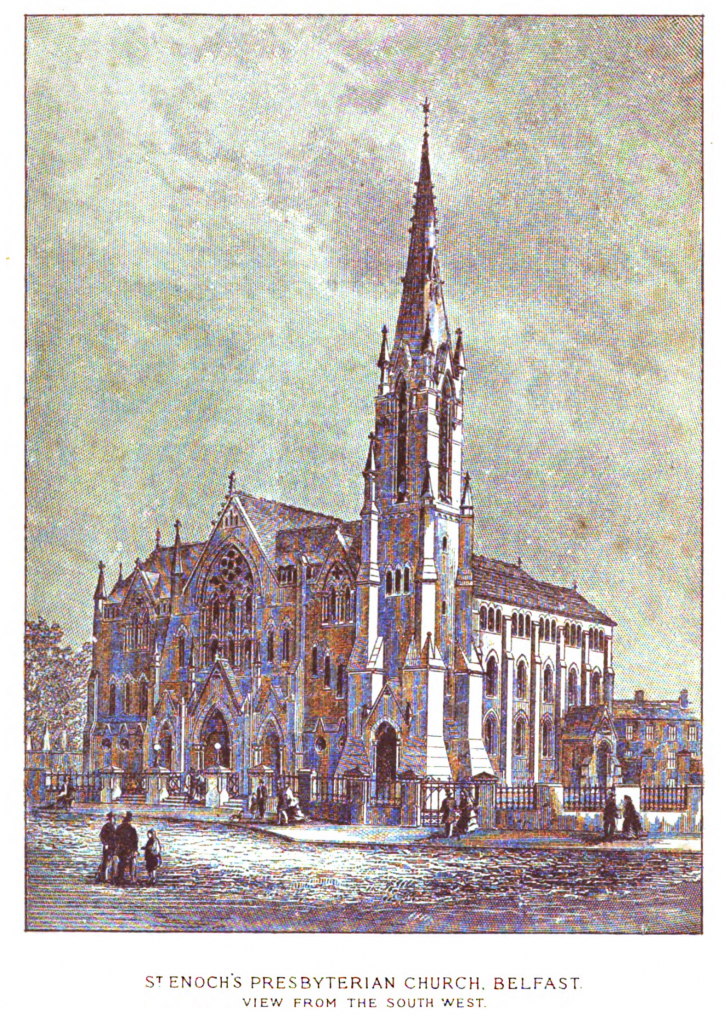
“St.Enoch’s Church, holding some 3,000 persons, was crowded to the utmost”